

East meets West
The first encounter between Japan and Europeans


Welcome to Cosmographia — a newsletter uncovering the deep roots of a turbulent world. For the full map of posts, see here.
Today’s post was written by the brilliant historian of Japan and Asia, Christopher Harding. Chris has written a number of excellent books on Japan, including Japan Story & A Short History of Japan, and made a number of documentaries on the subject for the BBC. He also writes a fascinating newsletter called Japan and the World, which I heartily recommend you subscribe to:

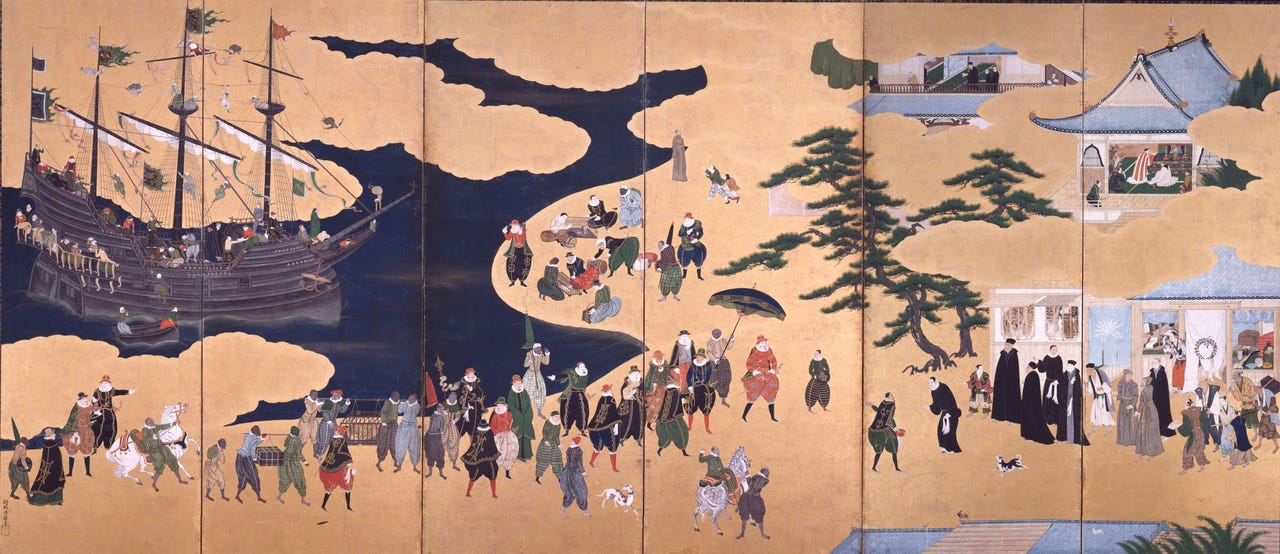
In 1542 or 1543, a storm-battered Chinese ship sailing out of Siam limped into port on the tiny island of Tanegashima, just off the coast of Japan’s southern main island of Kyushu. Aboard was a Chinese man named Wang Zhi, head of a criminal network spanning much of maritime Asia. He was travelling in the company of two strange-looking men whose appearances so worried the local samurai on Tanegashima that Wang Zhi felt he had some explaining to do. Taking a stick and scratching Chinese characters into the sand of a beach – he didn’t speak Japanese, so this would have to do – he laid out the essentials:
When they drink, they do not use the cup properly. When they eat, they do not use chopsticks but rather eat with their hands. They show their feelings without any self-control and do not comprehend the principles that lie within written characters. They wander from place to place, bartering things which they have for those they do not have. They are quite harmless.
The two men in question were Portuguese traders: the first known westerners to arrive in Japan, inspiring the first known account given there of western mores and manners.
For all their novelty in East Asian eyes, the Portuguese shared something crucial in common with the Chinese and Japanese: they were heirs to a concentric view of the world. Almost two thousand years before, the ancient Greek writer Herodotus had set out a view of reality according to which the Greek-speaking peoples of the world were the very centre of human civilization. They spoke the right language, worshipped in the right way, and men treated their wives and families as they should.
Begin moving outwards from this central point, warned Herodotus, and life becomes progressively more barbarous. Go far enough towards the edge of the world – to India, for example (of which Herodotus seems to have had heard via Persian intermediaries) – and barbarity reaches the point where benighted human beings give way to new sorts of creatures altogether.
The Portuguese men who arrived on Tanegashima had inherited a Christianized version of this understanding of the world, according to which travellers to far-flung parts of the world should expect to encounter weird, godless peoples amongst whom Satan may have been operating all but unchecked since the dawn of time.
For the people of China, Sinitic culture took the place of Greece and Christianity: their country was the sacred centre, and nearby places like Korea and Japan were loyal tributaries. An Inner Asia zone followed, blessed by the Chinese language and the wisdom that it carried. Beyond this lay ‘external barbarians,’ for whose manners and behaviour there was no accounting.
The Japanese, under heavy Chinese influence across centuries, took a similar view of the world and the perils of its far-flung parts. The two Portuguese men, as introduced by Wang Zhi, appeared to confirm it: they were lacking in decency and discipline, ignorant of Chinese, and engaged in trade – one of the lowliest of occupations, in which a person produced nothing and simply swapped this thing for that. Arriving in Japan from a southerly direction, they and their kind became known as ‘southern barbarians.’
The century of contact between Europe and Japan that was unwittingly kickstarted by these two men ended up being shaped by concentric-cosmos assumptions and by a sense, on the Japanese side, that some differences were simply too great and too dangerous to be overcome.
Portugal, and later Spain, the Netherlands and England all established contact with Japan in the period spanning the second half of the sixteenth century into the first half of the seventeenth. None of them ever wielded the kind of power, whether military or economic, that would allow them to bend Japan’s leaders to their will. With the use of force impractical, they fell back instead on attempts at understanding the people of Japan in order to get what they wanted: trade, Christian conversions, alliances.
This is a period, as a result, that forces us to rethink our reductive and over-extended concept of ‘colonialism’ – frequently used now simply to condemn any attempt by a country or even a private company to project power or influence. The archetypal villain, looming somewhere in the background of such condemnation, is often nineteenth-century Britain: deploying a combination of military and economic power variously to crush, colonise, brutalise, brainwash and generally immiserate large swathes of the world’s population.
It’s possible to agree that such injustices occurred, and to reject the idea of one nation coercing another, while also allowing that colonial encounters were always more nuanced than ‘powerful’ versus ‘passive.’ People in colonised parts of the world were a great deal more than victims; they wielded influence of their own, shaping these encounters according to their own hopes, desires and prejudices.
Wind the clock back a few centuries from the era of modern empires, to the arrival of those first Europeans at Tanegashima, and you see this idea vividly in action. Portugal’s massive and well-armed carracks dominated Asian waterways in the latter part of the sixteenth century. But the Portuguese were never a great territorial power. As their influence grew in Japan, they had no choice but to operate on the basis of curiosity, respect, deal-making, persuasion and the forging of fragile friendships.
To get a sense of this process, it pays to explore it almost in reverse. In the 1630s, around the time that most European friendships with Japan were withering away, a book was published in Kyoto called Kirishitan Monogatari (Christian Story). This is how it recalled the arrival of some of the first Europeans in Japan:
A southern barbarian trading vessel came to our shores. From this ship for the first time emerged an unnameable creature, somewhat similar in shape to a human being, but looking rather more like a long-nosed goblin. Upon close interrogation, it was discovered that this was a being called Bateren [Christian priest].
The length of his nose was the first thing which attracted attention. It was like a conch shell attached by suction to his face. His eyes were as large as spectacles, and their insides were yellow. His head was small. On his hands and feet he had long claws. His height exceeded seven feet, and he was black all over. Only his nose was red. What he said could not be understood at all. His voice was like the screech of an owl.
These strange creatures, argued the Monogatari, had been opportunists. Back in those days, the 1540s, Japan had been riven by civil war and its Buddhist establishment deeply corrupt –monks preaching the casting off of desire from atop gilded thrones. A weak and sickly national body had been easy prey for foreign vermin. They posed as Buddhist and Confucian teachers before demanding that their listeners abandon both traditions in favour of their own ‘cursed doctrine,’ which centred upon the ‘gruesome’ image of a man hanging from a cross.
These barbarians manipulated people’s emotions and tempted them with ‘beads,’ ‘baubles’ and ‘new-fangled bric-a-brac’ from aboard the giant ships sailed into Japanese harbours by their trader compatriots. Japan was on the verge of becoming a ‘domain of devils,’ but then the virtues of strong leadership and proper conduct were rediscovered and the foreigners were ejected – ‘without being allowed to grasp an inch of our soil.’
The Kirishitan Monogatari was clearly a polemic. But it reveals something true: the first encounter of westerners with Japan foundered not on misunderstanding but on the anxieties that an accurate understanding inspired. What began as a fairly superficial set of mutual observations – differences in physical appearance, diet, dress, manners and language – turned, on the Japanese side, into a genuine sense of foreboding about who these visitors were and what they wanted.
Portuguese influence in Japan – which peaked in the 1580s and then faded away from the early 1600s onwards – rested on two things: wealth and weapons. Trade between China and Japan had been suspended for many years by this point. Pirates like Wang Zhi had been busy terrorising coastal populations in China, and Japan’s leaders appeared unable or unwilling to do anything about it: Japan was in the throes of a long civil war, allowing the likes of Wang Zhi to operate with impunity from its caves and coves. The Portuguese filled this very lucrative trading gap, shipping Japanese silver across the China in exchange for Chinese silk. A portion of the vast amounts of money thereby made was paid to selected warlords in Kyushu, who allowed their ports to be used by Portuguese ships.
Alongside trading profits, the Portuguese also offered their warlord allies generous supplies of guns and ammunition. This technology was all but unknown in Japan before those first two Portuguese arrived at Tanegashima and worked their way into the local lord’s good books by showing him how to fire one. Soon, they were being used in battles all across Japan. Armies in this era were enormous, and included large numbers of peasant conscripts. It took a long time to teach one how to use a bow and arrow well. Learning how to point a gun and pull a trigger was a far quicker process. Few would prove to be gifted snipers, but put enough arquebusiers in a row and have them all shoot in the right general direction, and an enemy cavalry charge would collapse.
Had the story of East-meets-West in the sixteenth century been simply about money and guns, it might have featured longer-lasting relationships – albeit much less interesting ones. Instead, deepening and shortening this first era of encounter was the newly-formed Society of Jesus, or ‘Jesuits.’ They used Portuguese shipping as a global taxi service, hailing rides out to India, China, Japan and elsewhere as they sought to counter Protestant progress back in Europe by demonstrating the global reach and appeal of Catholicism.
They got a foot in the door, in Japan, largely by promising to persuade Portuguese traders which ports to use when they arrived with their goods. A Kyushu warlord in need of funds and weapons to see off a rival might agree to give the missionaries free rein in preaching the gospel – or might even receive baptism himself – in exchange for having an eminently-taxable carrack dock in his domain.
A warlord who converted to Christianity could require his vassals to do likewise, meaning that Christian samurai soon became a common feature of life in Kyushu. Though the proportion of people in Japan as a whole who became Christians never rose above 2%, in some parts of Kyushu that figure was close to 50%. This was where westerners’ problems in Japan began.
The first missionaries and their Japanese co-workers and converts were largely tolerated, even by the up-and-coming warlord of the era over on Japan’s main island of Honshu. Oda Nobunaga was busy fighting not just secular rivals but also powerful Buddhist organisations, some of which were capable of fielding their own armies. Christians, too, regarded Buddhism as their enemy – though for different reasons – so they earned Nobunaga’s sympathy while also piquing his interest as visitors from far away who arrived bearing interesting technologies and trinkets.
But Nobunaga’s expanding domain never reached Kyushu, so he never saw for himself what Christianity had wrought there: thriving communities of Japanese Christians bearing European names, singing European hymns and implicitly recognising a hierarchy that stretched upwards not to Nobunaga and the Emperor – powerless yet revered – but instead to the Pope in Rome and ultimately to a divine power who demanded that his followers renounce all rivals. Oda Nobunaga’s successor, Hideyoshi Toyotomi, did see all of this, when he conquered Kyushu in the 1580s. Though the lure of trade helped to restrain him from throwing all Europeans out of Japan and banning Christianity outright, he was incensed at what he heard of Shintō shrines and Buddhist temples being destroyed by zealous converts, while Japanese men, women and children were kidnapped and sold as slaves abroad – a practice in which some Jesuits appear to have been complicit, though others vigorously opposed it.
It was Hideyoshi who first took seriously a notion that had been doing the rounds in Japan for years by this point. It began with a deep-seated East Asian condescension towards trade, as a lowly activity. Not only did the Portuguese who ended up in Japan appear to relish this ignoble – if profitable – occupation, they had abandoned their countries and families in order to pursue it on the other side of the world. Why? Had they been exiled, perhaps as criminals? Or maybe ‘home’ was a sad hovel, from which they had been determined to escape.
Others in Japan wondered about the missionaries in particular: why would they give up so much, simply to come to Japan to tell people about their God? Might it be that they were here to soften Japan up for foreign invasion? What better way of achieving such an aim than to win people’s sympathies, via a highly emotional set of teachings, and then demand that they rise up in support of an invasion force?
Fears like these, made worse by rivalries between the Portuguese and the Spanish – who established themselves in the Philippines – led to Hideyoshi having twenty-six Christians crucified outside Nagasaki in 1597. A mixture of Japanese and European Christians, they became known as the ‘Twenty-Six Martyrs.’ After Hideyoshi died, and Tokugawa Ieyasu succeeded him – completing the re-unification of Japan in 1600 – it was this phenomenon of martyrdom that finally soured relations between Japan and Europe.
Buddhism had succeeded in Japan, many centuries before, by accommodating itself to Japanese culture while offering something valuable. The idea was developed that Buddhist and Shintō deities were manifestations of the same sacred realities, and that Buddhism’s primary purpose was to serve the Japanese state and the people of Japan. Buddhism’s foreignness, as an Indian teaching imported via China and Korea, eventually fell away.
The Judaeo-Christian view of the world sat badly alongside this syncretic approach, steeped as it was in the renunciation of false gods and life’s counterfeit goods. Even then, it is possible that given more time and different circumstances, western relations with Japan might not have ended as they did. But by the 1620s, leaders in the new Tokugawa shogunate – still relatively fragile, after a long period of civil war – were persuaded that Christianity was a security threat that could not be overcome.
When limited prohibitions on Christianity were flouted and Christians were executed as a result – many burned at the stake – other Christians came out to comfort them and sing hymns. There was sometimes a festive atmosphere, as though this were not ignominious punishment but rather the achievement of something great. This, in fact, was how Jesuit martyrdom manuals described it. There were meanwhile instances of senior Christian samurai choosing faith over fief, when forced to decide between them. And when the English and Dutch – Protestant powers both – arrived in Japan, they let it be known that you could never trust a Catholic, let alone a Jesuit or a Franciscan.
The days were long gone, now, when the most threatening feature of western visitors was their lack of table manners or their infrequent bathing. Such habits could be modified – and indeed the Jesuits did their best, hoping to win Japanese respect by taking more care of their appearances, learning Japanese and performing the tea ceremony. Harder, by far, to uproot a person’s deepest loyalties, their most fundamental convictions about the world.
It now seemed obvious to the shogunate that westerners had injected a kind of poison into Japan’s body politic, and that a dramatic course of treatment was required. Across the 1620s and 1630s, moves were made to expel the Portuguese and Spanish and to ban Christianity – on pain of cruel tortures. The Dutch became the only Europeans permitted to trade with the Japanese (the English having given up on the country a few years before), and even they were confined to a small artificial island in Nagasaki Bay.
Polemical takes on Japan’s European interlude, in the vein of the Kirishitan Monogatari, penetrated Japanese thinking about the outside world so thoroughly over the next two centuries that they helped to shape the reopening of relations with the West in the mid-nineteenth century. When Commodore Matthew C. Perry arrived in Japan in 1853, seeking friendship while threatening violent retribution, Japanese artists drew him in the style of a classic southern barbarian: excessively hairy, long nose, evil-looking eyes and a goblin-like appearance. Those in Japan who objected to the country’s steady opening up to the West took as their slogan: ‘Revere the Emperor! Expel the barbarian!’
By the turn of the twentieth century, the dominant trend in Japan ran decisively in favour of learning from the West, from industry to law. But something of that first century of encounter lingered. Critics of European science and technology argued that for all their achievements they betrayed a certain soullessness in relating to the world: ‘their only values,’ claimed one Confucian scholar, of westerners in general, ‘are fact-gathering and technique.’ One of the reasons why most westerners have heard of Zen Buddhism but not of the equally important Jōdō Shinshū sect is that a handful of Japanese Zen evangelists around the turn of the twentieth century successfully made the case that Zen was a way for disenchanted westerners to reconnect with reality.
The most obvious carry-over from that first century of contact has been the conviction amongst many Japanese, from the late nineteenth century down to the present day, that Christianity is a western rather than a truly universal religion. Small numbers of former samurai became Christians at the end of the nineteenth century, as did other Japanese besides. But suspicions remained of a foreign cultural force threatening to undermine Japanese life – not helped when the Russo-Japanese War of 1904-5 was framed, by some in Japan, as a war against Christianity. Japanese Christians were often suspected of having only a rather watery sort of loyalty to the Emperor and to their modernised homeland, lumped in with the country’s much-criticised globe-trotting diplomats as people who appeared to prefer the company of foreigners.
Fast-forward to the present day and those in Japan who wonder whether foreign tourism to places like Kyoto is nearing a tipping point will no doubt regard Wang Zhi’s observation that Europeans ‘show their feelings without any self-control’ as another feature of that old encounter that remains all but unchanged. You only have to stand back and observe the dynamics in a convenience store, on a train, or in a temple to sense the changed atmosphere when a critical mass is reached of well-meaning yet naturally more demonstrative westerners. The space becomes livelier or noisier, depending on your perspective, and though you won’t see many Kyotoites complaining, Japanese TV and social media reveal considerable frustration and concern for the future.
These concerns fuel a fairly mainstream argument in Japan – in no small part a legacy of the first century of encounter with the West – that across history a largely peaceful island nation has regularly been interfered with from outside. The popularity of the Edo period (1600 – 1853) as a setting for novels and TV dramas says it all. Here, so the argument goes, was Japan’s cultural heyday: an era sandwiched between two periods of western meddling, in which foreigners mostly minded their own business and the Japanese were allowed to get on with theirs. You don’t have to agree with this view of the past and present to at least see the point: that for some people, encounter is all well and good – but it can go too far, become too intimate, and leave one or both sides crying out for a little time alone.

If you enjoyed this post, please do subscribe to Chris’ substack newsletter, Japan and the World.
 | A guest post by
|
Super interesting!
Excellent work. I haven’t been able to find Chapter Four.