

Interpreting the Odyssey
(Spoiler Warning)

Welcome to Cosmographia — a newsletter dedicated to exploring the world and our place in it. For the full map of posts, see here.
This essay contains a spoiler for a major theme in Christopher Nolan’s new film, The Odyssey, that was not in the original poem. If you haven’t seen it yet, I would suggest holding off reading this piece until you have.
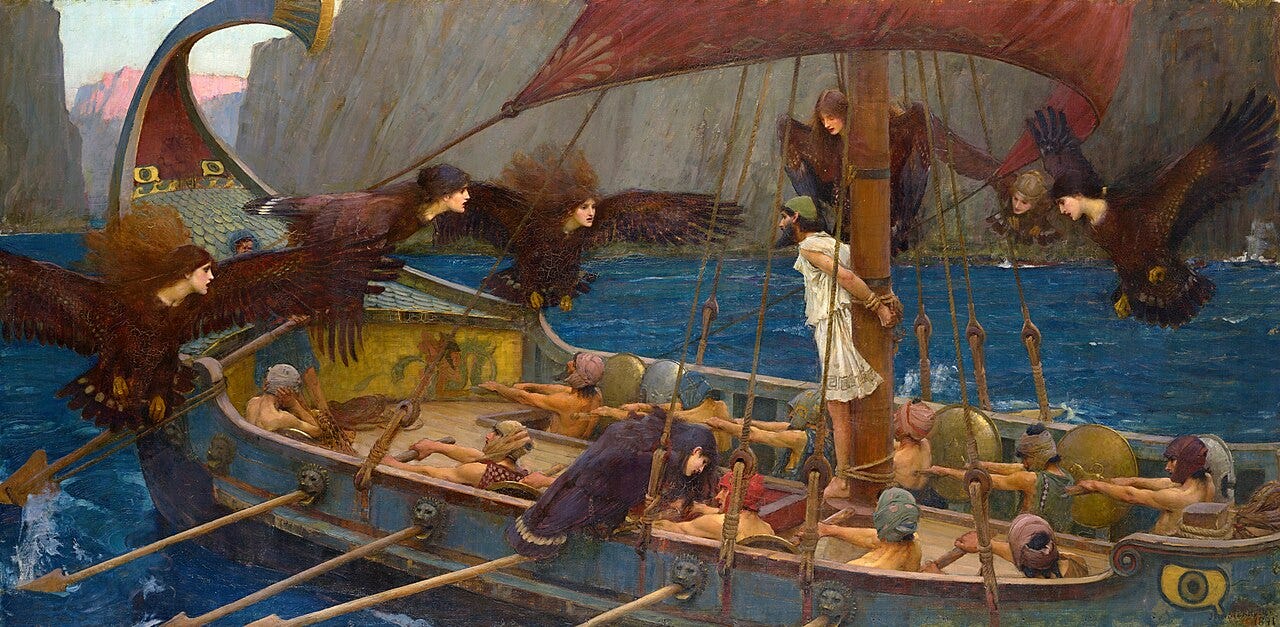
Homer’s Odyssey is one of the great stories of world literature not because of its great age, its mastery of narrative, its myriad themes, fantastical monsters, and unforgettable characters (not least Odysseus himself), but because like all great tales it holds up a mirror to its beholder. In the two thousand seven hundred year old story, written during and for a time in history that is more alien to us than we could ever hope to understand, we can find within its storied lines all the anxieties and obsessions of our own age. What makes the Odyssey Great Literature is its polymorphism - its infinite capacity for reinterpretation.
The Iron Age Greeks contemporary to Homer himself did not separate truth from fiction as readily as us, so the extent to which they believed the events described in the epic as either ‘true’ or ‘invented’ is not a framing they’d have understood. They believed wholly in the gods’ propensity for meddling in human affairs, while their understanding of the world’s hardships and fortunes and mysteries made no sense without their invocation. They took Homer’s themes of nostos (homecoming), xenia (hospitality), and restoring the world to its rightful order, quite literally.
By the time of Classical Greece, a few centuries later, attitudes towards the story had already begun to shift. While the original readers and listeners of the Odyssey would have no doubt celebrated Odysseus for his cunning and trickery, by the 5th century BCE the Athenian playwrights Sophocles and Euripides were recasting him as a cynical liar - a literary device used to criticise the demagogues of their day.1
The Stoics meanwhile admired the Greek hero for his ability to endure suffering and resist temptation, while the Cynics lauded his rejection of luxury and vanity. The Romans tried to have it both ways, casting ‘cruel Ulysses’ as both the treacherous villain behind the Trojan Horse, while at the same time they via Virgil retold the Odyssey entire as Rome’s founding myth (the Aeneid).
The great Neoplatonist Porphyry viewed the poem as an allegory for the soul’s journey through the material world back to its true spiritual home, heaven. Some early Christians viewed Odysseus tied to his ship’s mast while listening to the Siren’s song (standing in for worldly sin) as an early typological symbol of Christ on the cross, while later believers condemned him for his lies. Dante put the hero in his Inferno for both his fraud and his thirst for forbidden knowledge.
The Renaissance saw Odysseus recast again, this time as the ideal ‘universal man’, adaptable, prudent, curious - the same qualities that the mediaevals condemned were celebrated only a few centuries later. The explorers of the burgeoning European Age of Discovery were quick to see the parallels between their expeditions into the unknown and Homer’s epic, while François Fénelon’s novel Les Aventures de Télémaque (1699) turned the story into a polemic on the dangers of absolute power - widely understood at the time as a thinly veiled critique of Louis XIV.
Tennyson’s Ulysses (1842) was a restless striver who couldn’t abide inaction, his lodestar the desire ‘to strive, to seek, to find, and not to yield’. In this we see Odysseus cast as the ideal of Victorian imperial energy, a civilising wanderer. Similarly, C.P. Cavafy’s Ithaka (1911) envisions the Odyssey as the grand metaphor of life, in which one should not seek to rush to one’s destination too quickly, but instead relish the journey.
The great English-language modernist masterpiece, Joyce’s Ulysses (1922), relocates the stuff of epics to the ordinary everyday. After the two World Wars, it also became common to see the poem as a story about what war does to men.
More recent years have seen a litany of new feminist retellings - Atwood’s Penelopiad (2005), Miller’s Circe (2018), Pat Barker’s Silence of the Girls (2018), and Natalie Haynes’s A Thousand Ships (2019) - while Emily Wilson’s 2017 translation chose not to shy away from the poem’s depictions of slavery.
What all of these reinterpretations of the Odyssey have in common, different as they may have been in substance, is that they all reflect the anxieties and concerns of their time. So it is with Christopher Nolan’s film.
(Spoilers coming below - you have been warned!)
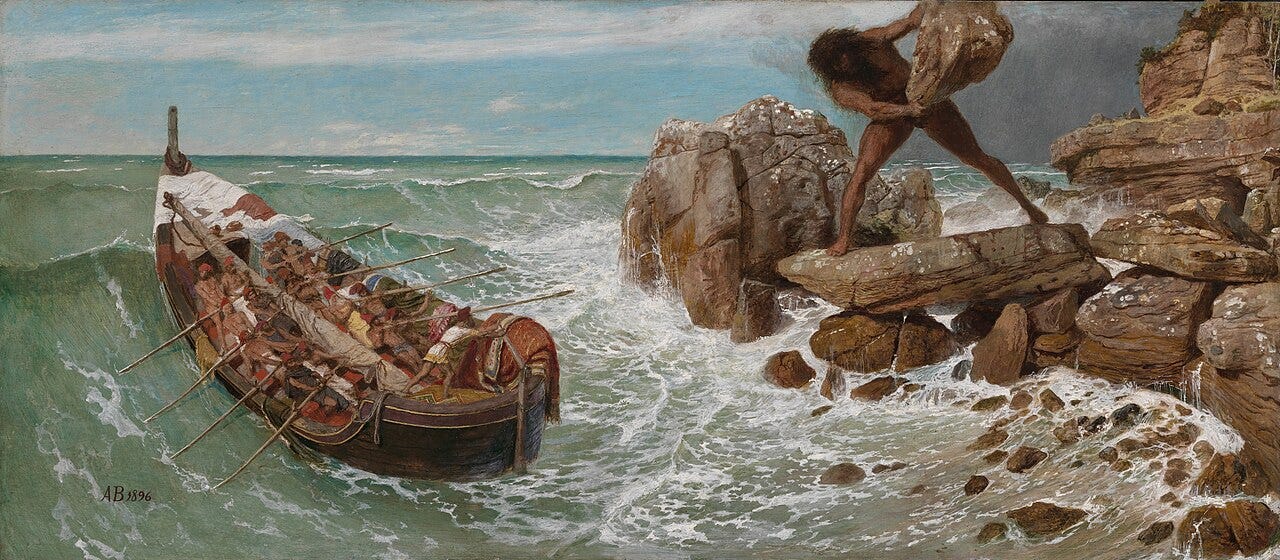
Before the new movie was even released Nolan’s Odyssey has been dogged with controversies over its casting choices, anachronistic costumes, and other historical inaccuracies. These were all at their heart complaints that the film would not be true to the original source material, that it seemed to be imposing modern (some would say woke) moral and aesthetic standards upon one of the foundational texts of Western civilisation and culture. To put it another way, people were complaining that Nolan was daring to reinterpret the Odyssey, rather than simply retelling it, which in their view was something akin to a cardinal sin.
Now the film has hit cinemas and reviews have started to come in, this same hostility to the idea of reinterpretation has manifested itself in a few other forms. Some have criticised its portrayal of Odysseus as a listless and regretful figure, quite unlike his character in the epic, while others have railed against the imposition upon the Homeric tradition of a quintessentially Christian cautionary tale. Indeed it is true that the great theme permeating the new film is not one you would find in Homer. It is, however, one of the great anxieties of our time.
From beginning to end there is in Nolan’s Odyssey a mysterious threat lurking in the background of an otherwise familiar plot. It hangs over Telemachus and Penelope as they try to manage Ithaca and their household without their king. There are rumours circling the Aegean of a shadowy force, a people from the sea, who are raiding cities across the Mediterranean, violating as they go traditional norms of hospitality and friendship. This is almost certainly a nod to the mysterious but historically attested Sea Peoples, a collection of marauding pirates that attacked the Eastern Mediterranean seaboard during the Late Bronze Age. Traditionally these raids, which affected Egypt, the Hittites, Phoenicia, and Mycenaean Greece, were thought to have been the primary cause of the Bronze Age Collapse - a period of societal breakdown that afflicted societies all around the eastern rim of the Mediterranean basin in the late 13th to the early 12th centuries BCE, a period roughly coterminous with the real life Trojan War (to the extent it truly took place).2
The anchoring moral of Nolan’s film is its recasting of the Greeks - Odysseus, Agamemnon, Achilles, Menelaus, and the rest - as these people from the sea. The very threat hanging over Penelope’s Ithaca was Odysseus himself. His actions at Troy, the trick he devised to get behind the famed walls of the city, violated the age-old customs governing xenia (hospitality), and in the process had irrevocably destroyed the rules binding society together. Odysseus’ cunning won the battle for Troy, but lost the war for civilisation. We leave the characters at the end of the film reflecting on their doom.
The critics of this very modern interpretation of the ancient story are wholly correct in their claims that this diverges from the poem. Of course it does! All retellings are necessarily reinterpretations, and all reinterpretations must necessarily diverge from the original. Homer would have been as baffled by Dante’s Ulysses as he would have been by Madeleine Miller’s! All the retellings I’ve mentioned in this essay are anachronistic, because they all speak more to their own times than to Homer’s.
And what is a more modern obsession than the idea of the fall/decline of Western civilisation? We are living through a turbulent moment, a transition between eras. The world we once knew seems to be dying before our very eyes, while the shape of the new order is yet to be born. There are many who claim the West as we know it is doomed. America is faltering, they say, Europe is under attack, our societies are tearing themselves apart. (Ironically, it’s the same people who were most incendiary about the woke casting in this movie that are often those most vociferous about the threat of civilisational collapse.) But whether or not you believe this threat to be real, it is undeniable that it remains one of the great anxieties of our age, and thus is entirely legitimate as the central conceit in this, the latest incarnation of the story.3
The Odyssey is a tale that has been told and retold for thousands of years and was old even as the version traditionally attributed to Homer was first set down in ink. Indeed the idea of there being one and only one canonical and correct version of the story would have been news to the ancients. Whether or not you like Nolan’s interpretation or not is a question of subjective and personal taste - I will certainly not deign to tell you what you should make of it. But one thing that cannot be claimed is that it violates the spirit of the original, because there are none alive who can claim knowledge of the earliest kernel of the story of the man of many devices, those lines have with the breath of the nameless poet who first uttered them been lost forever to the winds of time.

Sophocles actually presents two different interpretations of Odysseus in his works - immoral in Philoctetes, compassionate in Ajax - showing that even the same writer can interpret the story in different ways.
Today historians agree that the Sea Peoples were a symptom of the collapse - displaced and militant refugees fleeing poor harvests and violence at home - rather than a primary cause.
Homer himself, such as he existed, lived between golden ages. He was aware that he was living in the shadow of a mighty civilisation (Mycenaean Greece) that had long ceased to be. But the greatest flowering of Greek civilisation, the Classical period, lay only in his unknowable future.
Very nice overview of the treatment of Odysseus/Ulysses in the subsequent literary tradition. I'd like to add one more title, Nikos Kazantzakis' "The Odyssey: A Modern Sequel," translated by Kimon Friar. Kazantzakis was very well-known way back when I was young; his best known work is "Zorba the Greek" which was made into a wonderful movie starring Anthony Quinn.
His "Odyssey," however was really his magnum opus. FWIW, it includes three lines that I think are among the sexiest lines of poetry I've ever read:
A woman's body is a dark and monstrous mystery;
between her supple thighs a heavy whirlpool swirls,
two rivers crash, and woe to him who slips and falls!
I haven't seen the movie yet; maybe I will, maybe I won't. Probably will, at some point. I'm a former classicist and am not sure I'm ready for his reinterpretation. Homer's Odyssey is so wonderful as it is, I worry about people messing it up.
I agree Chandi. Retelling apparently is always an outcome because different people with different perspectives interpret events and causes differently as they are influenced by their own life experiences. The Odyssey is a tale rich in imagery embedded in a theology that few today know anything about. Yet the poem is a skeletal structure upon which can be developed a fleshed out story of our own individual lives. Yet, even in this, the search continues for the good, the true, and the beautiful.