

Understanding Iran
A new series

Welcome to Cosmographia — a history of the earth and the stars. For the full map of posts, see here.
This is the first in a series of posts on the history and culture of Iran, one of the world’s great civilisational centres.
We in the West are the intellectual progeny of two intertwined traditions — classical antiquity and Christianity — and our modern secular humanist values are the product of those traditions. Like fish in a tank, we struggle to see the waters in which we swim and find it difficult to identify this line of descent, taking instead our modern values as entirely self-evident and emerging spontaneously. As such, we are often unable to understand that other traditions/civilisations do not take the same values for granted, coming as they do from different lines of philosophical heritage.
With this in mind, I’ve been kicking around an idea for a format on Cosmographia for a long while, in which I attempt to delineate the philosophy, history, and culture of a non-Western civilisation (e.g. China, India, Arabia) in an attempt to better understand how they make sense of themselves, their place in the world, and what they make of us.
This is obviously quite a grand undertaking and I have no idea if I’m up to the task but thought it would be fun to at least attempt. My original thought was to start closer to home with a quasi-western civ like Russia but in light of recent events it’s clear that we could all benefit from a deeper understanding of the Persosphere, so we begin instead with Iran.

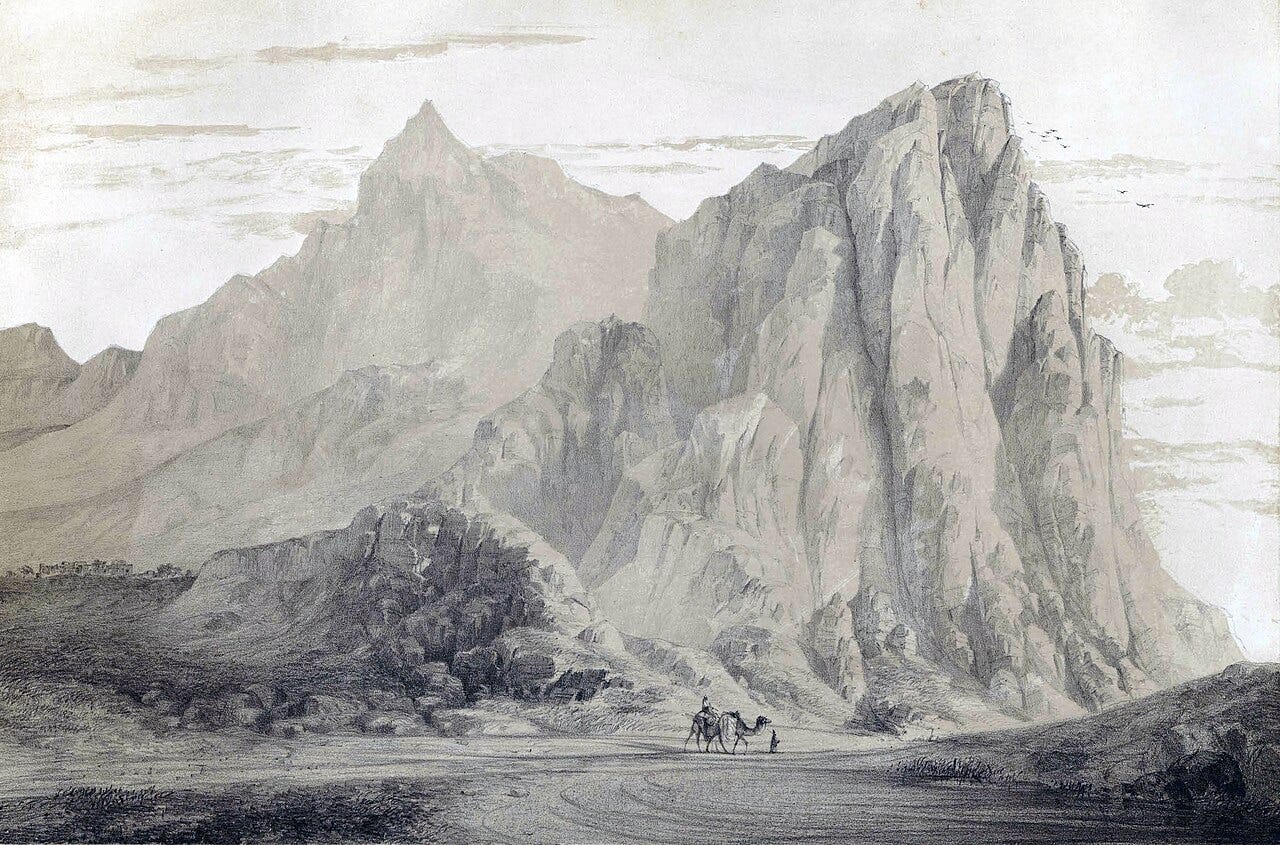
East of the Holy Land, east of Mesopotamia, east of Sumer, the land begins to rise. It rises out of the river plains and the silted lowlands of the Tigris and climbs, ridge upon ridge, through the jagged folds of the Zagros Mountains until it breaks upon a vast tableland a thousand metres above the sea. This is the Iranian plateau. It stretches for twelve hundred miles from west to east, walled in by four mountain ranges and two seas. In its interior there is almost nothing. Two great deserts of salt and sand — the Dasht-e Kavīr and the Dasht-e Lūt — yawn empty and bescorched. Indeed, in the summer months the Lūt is the hottest place on earth. The wind that crosses it carries no moisture; it strips the rock bare and scours the sand into yardangs that resemble the fallen bones of some long dead beast.
With such forbidding geography, one would be forgiven for thinking the lands of the plateau would be boundless and bare. Yet, people have lived here for a very long time.
Some of the first tribes of Homo Sapiens to have left Africa made their home in these highlands. It’s thought that in the remote valleys of the Zagros Mountains some of our ancestors interbred with Neanderthals. Later, soon after the first farmers began planting wheat and barley in the Fertile Crescent to the west, hillsmen in those same valleys domesticated the humble pea and lentil. Not long afterwards they tamed the goat too. And as the lands of Sumer gave birth to the earliest urban culture known to history, the Elamites began forging a culture of their own in the lowlands of Khuzestan, raising great cities at Anshan and Susa. From there they warred with the great Akkadian Empire, which was eventually finished once and for all by Gutian nomads who raided the silted plains of the Tigris and Euphrates from their strongholds upon the plateau. But all this was merely preamble compared to the splendour of what came after.

Some forty centuries ago, a new people began to emerge out of the Central Asian steppe. They called themselves Ārya, the noble ones, and they came from the north: out of the grasslands beyond the Oxus, down through the passes of Khorasan, into the highlands with their horses and their war chariots and their god of the sky. This first wave split in two: one group passed straight over the Iranian plateau and into the Levant, where they founded the Mitanni kingdom; the second meanwhile threaded their way through the labyrinthine passes of the Hindu Kush and onto the Gangetic basin, where they began the Vedic Age of India.
But some of the Ārya stayed upon the steppe. We have not yet the data to trace their exact transformation but after another thousand years of haunting the plains their descendants emerged from the great grasslands as something distinct to their forebears: they had become the Iranians. These peoples would dominate the steppe for two and half millennia, with the Scythians riding their horses as far west as the Greek Aegean, while the Sogdians dragged their caravans from the Caspian Sea to the courts of imperial China. But it was the small group who headed south to settle the highlands of the land that in time would come to bear their name that we most associate with the tribe.
Around the same time as the Iranians first entered Iran, a man among them climbed into the mountains at the far northeastern edge of the plateau. Upon those lofty peaks he sat in silence. His name, or the name that came down to us, was Zarathustra Spitama. What he saw or heard up there we can only guess at through the hymns attributed to his hand — the Gathas, among the oldest religious texts on earth — but what he brought back down from the mountain would go on to shape the faith of far more than just Zoroastrianism, the religion he founded. He declared that the universe was a battleground between Truth and the Lie, between a god of light and wisdom, Ahura Mazda, and a spirit of darkness and destruction, Angra Mainyu. He declared that human beings must choose between light and dark. He declared that the dead would be judged, that the righteous would be raised, that a saviour would come at the end of days to purify the world in fire. Heaven, hell, judgment, resurrection, apocalypse — these concepts did not originate in Jerusalem. They were born up there, upon the plateau.
As the Iranians settled the valleys and passes of Iran, they mixed and intermarried with those they found there. They absorbed the beliefs and customs and genes of those they had overrun, and out of this mixing there emerged, slowly, over centuries, something new. Two tribes coalesced above the others: the Medes in the northwest; the Persians in the south. And it was the Persians, under a tribal chief named Cyrus, who in the sixth century BC exploded out of the highlands and built the largest empire the world had ever seen, stretching from the Bosphorus to the Indus. The columns of Persepolis were raised up; the Royal Road was cut into the earth for seventeen hundred miles; twenty-three nations sent tribute to the King of Kings.
That empire eventually fell to Alexander, who burned Persepolis in a drunken rage. But from its ashes the Parthians rebuilt an Iranian kingdom, and after them the Sassanids rebuilt it again. They reformed Zoroastrianism and fought Rome to a standstill for four hundred years. Then the Arabs came with a new god and a new book and broke the Sassanids at al-Qadisiyyah in 636 AD, and that should have been the end of it. But it was not.
The Persians, conquered, did what the Persians have always done. They swallowed their conqueror whole. Within a century they were running the Arab empire — its bureaucracy, its scholarship, its poetry, its philosophy. The greatest scientists and physicians and mathematicians of the Islamic Golden Age were, overwhelmingly, Persian. The language of high culture from Constantinople to Delhi was Persian. When the Turks conquered Iran the Turks too were persianised. When the Mongols conquered Iran and annihilated its cities and slaughtered its people in numbers untold, the Mongols too, within a generation, became Persian — commissioning miniature paintings and reciting verses from the Shahnameh, the great national epic of the Iranian people. And when the Safavids seized power in 1501 and forcibly converted the country to Shia Islam — an act of religious revolution as radical as anything in the Christian Reformation — they did not sever the link to Persia’s deep past. Instead, they fused it with something new, and forged from the union the strange, proud, grieving, defiant thing that is modern Iran.
Persia is a civilisation that does not die. It has been conquered, sacked, burned, occupied, partitioned, humiliated; it has endured foreign religions, foreign alphabets, foreign armies; it has watched its cities reduced to rubble and its libraries fed to the flames. But after each defeat she rises once more. Despite all the ructions this land has endured, modern Iranians still share 65% of their ancestry with the goatherders who stalked the valleys of the Zagros nine thousand years ago. The plateau abides.

In the Western imagination, this place calls to mind two opposing visions.
There is Persia: great enemy of the Greeks, the decadent bastion of Orientalist fantasy, of the Rubáiyát of Omar Khayyám, of turquoise domes and rose gardens and beautiful carpets. The Persia of Darius and Xerxes, of Hafez and Rumi. The Persia that gave us the word ‘paradise’. This Persia is rich, lovely, distant, and, in our minds, long dead.
And then there is Iran: black-robed, theocratic, hostage-taking Iran. The Iran of beetle-browed Ayatollahs, of ‘Death to America’, of women beaten to death in the street for showing their hair, of a nuclear programme that keeps neocons up at night, of thirty thousand protestors murdered in a single month. This Iran is the Iran upon which the US and Israel say they rain down their missiles.
But the truth is not so dichotic. Iran is Persia and Persia is Iran. One cannot understand one without the other. The turquoise domes stand still (American missiles not withstanding). Ordinary Iranians still read Hafez. The Eram Garden of Shiraz still blooms. And the forces that shaped the modern Iranian state — the geography, the history, the theology, the memory of foreign interference — did not arise spontaneously in 1979. They are the product of four millennia of civilisation layered on top of itself, each stratum bleeding into the next.
What makes the Iranians the Iranians? How did a scattering of steppe nomads become the progenitors of one of the world’s great civilisations? How did a sandy plateau of desert and mountain produce Zarathustra, Cyrus, Attar, Rumi, and Ruhollah Khomeini? As we watch hellfire rain down upon that ancient and storied landscape, we owe it to civilisational posterity to at least attempt an answer to these questions.

Over the next few weeks, we will attempt to see the world as it looks from the plateau. We will begin with the land and the peoples who first settled it. We will examine the religious and literary ideas that Iran loosed upon the world — ideas whose influence most Westerners feel without knowing their origin. We will follow the cycle of empire: Medes, Achaemenid, Parthian, Sassanid, each one rising from the ashes of its predecessor. We will watch the Arabs, the Turks, and the Mongols pour through the mountains and be consumed, one by one, by the civilisation they thought they had conquered. We will witness the Safavid revolution that made Iran Shia, and follow the long unravelling of the modern era — the oil, the coups, the revolution, the wars — to the broken regime that by its fingernails still bloodily clings to power, sending forth drone swarms from behind its mountains to set fire to the world.
The goal is not to retell Iran’s entire history. It is instead an attempt to map the mind of a civilisation far older than our own, to understand how it sees itself and its place in the world, and how it sees us. As you read these very words bombs rain down from the sky upon an antique land. No can say for certain what will come after this war is over. But if we are to understand how we came to this juncture, if we are to understand what might come next, we must understand what came before.
But all this world is like a tale we hear -
Men’s evil, and their glory, disappear.
— Ferdowsi, Shahnameh (1010 AD)

If you’d like to follow this series, please consider taking out a paid subscription. You’ll receive:
3x articles per week on art, history, and mythology
Unlimited access to the entire archive (250+ articles and essays)
A 16th-century woodcut of Edinburgh for your wall (for annual subscriptions only!)
This is needed. I studied the history of modern Iran in university, and, for a short while, worked intensively with Iranian refugees. In the last few days, I have seen so many ludicrously inaccurate statements about Iran. It is a country with a history and culture that is rich and complicated and the years since 1979 have been a brief blip out of the preceding millennia of civilization in that place - only to a country as young as the U.S., would mere decades be seen as culturally defining.
You rule. Really cool idea.