

What actually is Cosmography?
Plus, plans for Cosmographia in 2024


The beginning of a new year seems as good a time as any to actually explain the meaning of the word which gives this substack its name. Doing so should also help provide some context for many of the projects I have planned for Cosmographia in 2024.
The word ‘cosmography’ combines the Ancient Greek ‘gráphō’ (γραφή, to write or draw) and ‘kósmos’ (κόσμος, universe), and was used during the medieval and early modern periods to denote proto-scientific attempts to map the entire cosmos. It differs from geography (gê, Earth) in that its scope includes the celestial — other worlds, the heavens, creation — alongside terrestrial concerns like cartography, peoples, flora, and fauna. In essence, traditional cosmography was an attempt to unite history, geography, science, and theology all in one; a preposterously vast, yet dazzling endeavour.1
In a sense, one could conceive the entire human intellectual project as one giant work of cosmography. We are mortal beings born conscious into an unfathomably vast universe. Since we developed complex language, we’ve attempted to understand the world around us and communicate some semblance of its meaning to one another. We first developed animist religions and shamanism, then complex poly- and monotheistic traditions, philosophical enquiry, and, eventually, the scientific method. What is the corpus of philosophy, religion, history, geography, and science if not the attempt to map the universe and our place in it?
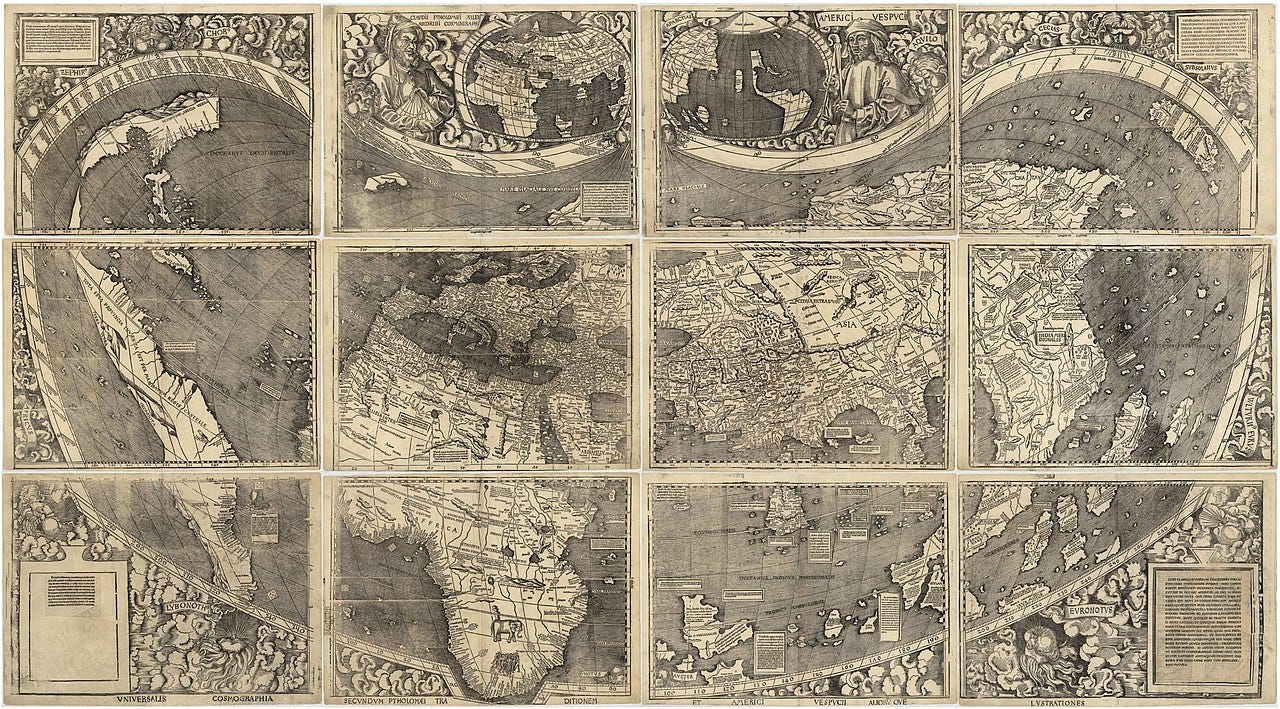
All that in mind, Cosmographia shall begin to reflect a wider project in 2024. Alongside our explorations of the history and art of places around the world, we’ll begin looking at its peoples, their culture, and their mythos too. We’ll be asking questions like: How did the Holy Land come to be so sacred?; How did the Silk Road come to be?; How do one people evolve from, or assimilate into, another?; What similarities exist between creation myths?; How do mythologies become integrated into the land itself? (These will all be accompanied by lots and lots of old maps, don’t you worry.)
In these explorations there shall be no free lunch, I’m afraid; almost all the most in-depth pieces will be behind the paywall. The Moleskine Notebooks shall remain free as they come out, but the full archive and the deeper Atlas Cultura journeys will require a paid subscription, such is the work they require to put together.
But, good news for those tempted to join the ranks of paying subscribers: twice a year we do sales for Cosmographia, and this is one such time.
For the entirety of January, paid subscriptions will be 30% off. This will be the only sale for at least six months, perhaps more, so take advantage of it while it lasts.
If, even with the discount, the price of the subscription remains beyond your means, you can gain access for free by sharing your unique referral link with new readers.
In the meantime, next time out we journey to Lhasa.
In more recent times, the word ‘cosmography’ has occasionally crept into astrophysics when referring to mapping large-scale features of the universe (things like galactic superclusters, the accelerating expansion of the cosmos, etc.), which is fascinating in its own right too.
I’m liking the expansion of topics. More history to learn! I swear every time I go by a shop window and see any kind of old map I think of you and wonder if you’ve seen one like that before. But you are in Europe so any maps you have there will be waaaayy better than any I find here in Canada.
Godspeed as you embark on this expanded journey. Taking us along for the ride as well. Many thanks.
“What similarities exist between creation myths?” Now that is something I want to read about right. This. Second!