

CHINA: ETERNAL RECURRENCE

Welcome to Cosmographia — a newsletter uncovering the deep roots of a turbulent world. For the full map of posts, see here.
This is the third in a series of posts on the history and culture of China. Read the first part here, and the second part here.

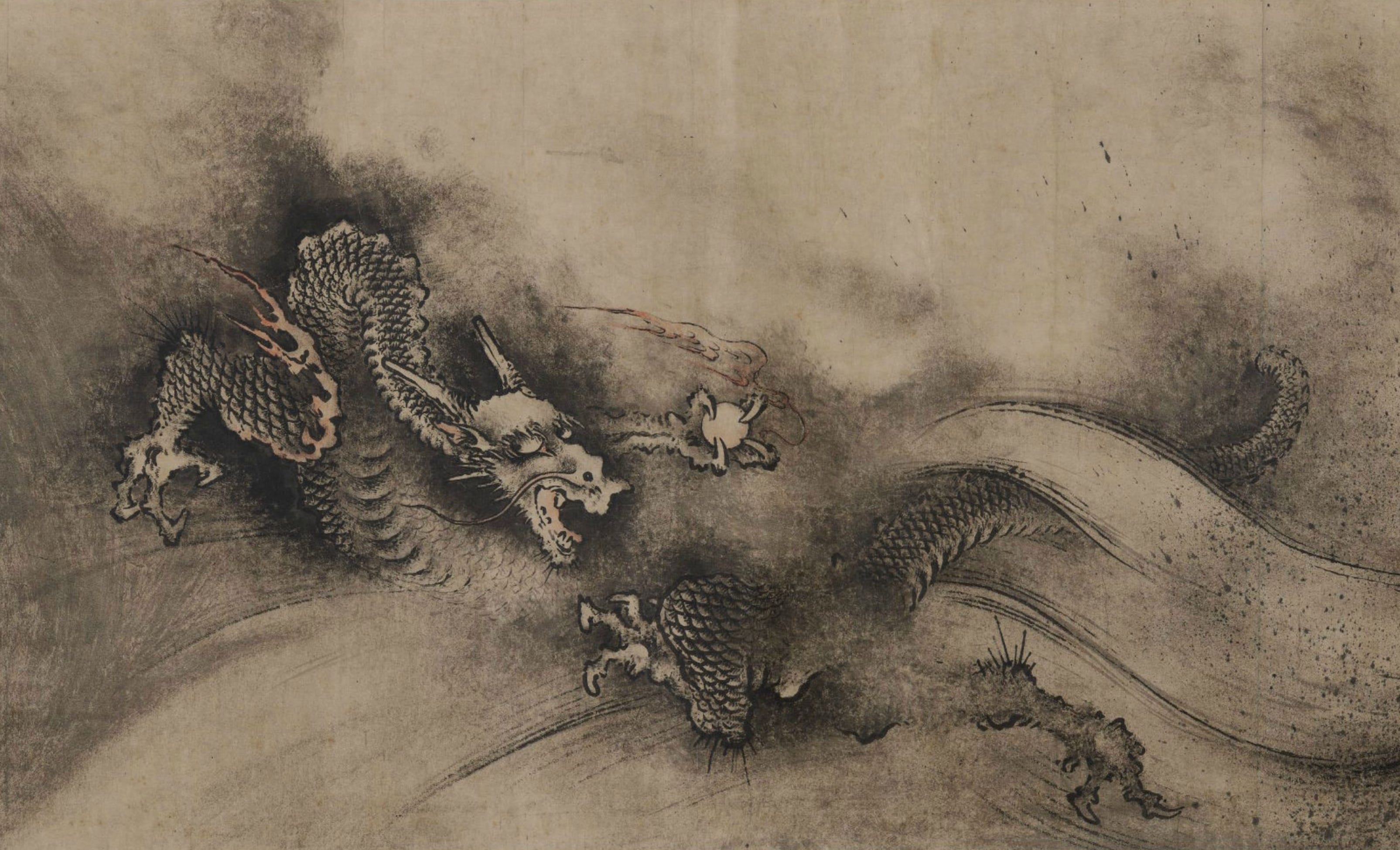
Returning is the motion of the Tao.
— Tao Te Ching, Laozi (4th century BCE)
There is a tendency here in the West to think of history as a straight line. A state of linear progression from our ape-like ancestors to Homo sapiens to agriculture and cities and civilisation, a more or less upward trend in technology, living standards, and moral virtue. Eastern traditions however, tend to conceive of history as a circle. China is no different.
For more than two thousand years China was governed by a succession of dynasties that rose, blossomed, began to rot, and then collapsed in on themselves, before the process began anew. The cycle went thusly: the Mandate of Heaven is bestowed upon a virtuous founder and his dynasty, order is restored to Zhongguo (中國), the Middle Kingdom; a golden age ensues. But then, inevitably, his weak and unvirtuous descendants let the empire slide into venal and moral decay; Heaven withdraws its favour, uprisings spring up, China falls into a state of luan (亂), chaos; the dynasty falls. The realm shatters into warring fragments, until somewhere among the ruins, a man with nothing left to lose raises his banner and begins the process of reunification once more.
Such is the deep-rootedness of this perception of history it appears as the great moral lesson of perhaps China’s most famous work of literature, the Romance of the Three Kingdoms (c. 14th century) - its opening line familiar to every educated Chinese: 話說天下大勢.分久必合,合久必分 - The empire, long divided, must unite; long united, must divide. The last imperial dynasty fell in 1912, and one can read the events that followed as yet another instance of the inevitable descent into luan: the Chinese civil war, the barbarism of the Japanese invasion, and the calamities of Mao Zedong’s ‘Great Leap Forward’ and Cultural Revolution. From the chaos of the 20th century has returned a confident, powerful, and stable China once more.
Fear of luan goes a long way to explain much about the country in the modern day. Disorder is feared more than tyranny, by both state officials and much of the populace. ‘Stability’ remains among the most favoured words in the CCP’s jargon, and is used to justify its vast surveillance apparatus, social credit system, and censorship.
The cyclical conception of history emerges naturally from a Taoist understanding of the cosmos. In fact, as we saw last time, Taoism, as well as Confucianism and Legalism, were born from their own period of luan - the Eastern Zhou era of Chinese history. In many ways the three schools of thought can be read as guides for extending the periods of order and stability, while trying to prevent the slippage into luan. Each of China’s many dynasties employed a different blend of the three schools in their governance of Zhongguo.
In this essay, we will trace the grand arc of Chinese imperial history through the turning of the dynastic wheel and its accompanying philosophical syntheses, from its first violent unification to the height of its last and largest empire. It is a story of order and chaos, of the flowering and ruining, over and over again, of one of the world’s greatest civilisations.
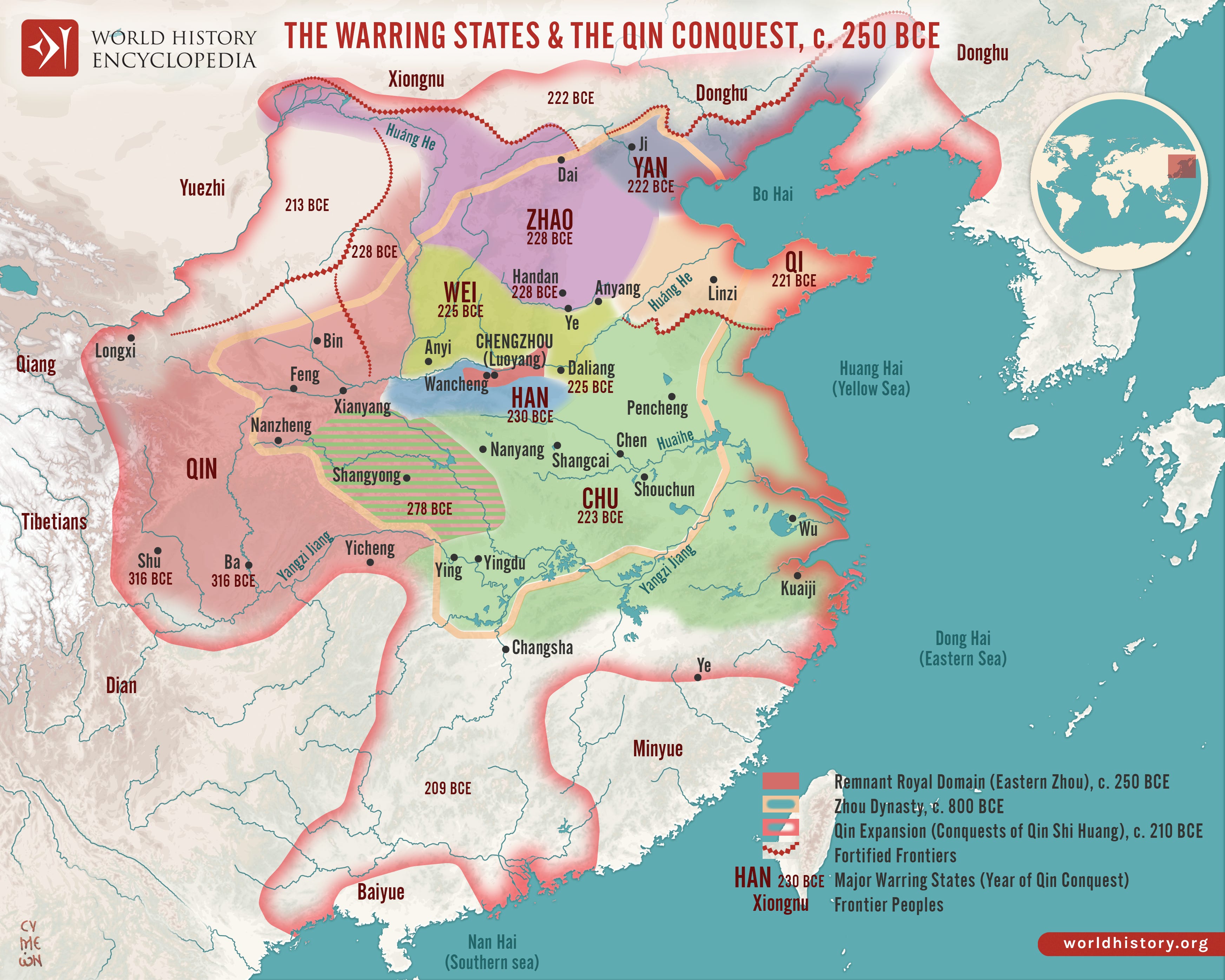
Throughout the tumult of the Eastern Zhou period (771-256 BCE), there existed among the warring states still a symbolic deference to the Zhou king, who lived in a great palace at Chengzhou. Since the crown’s flight east to establish a new capital in 771 BCE, its status had slowly diminished to become little more than a symbolic figurehead, used to legitimise the succession of the noble-houses-turned-kings, akin perhaps to the Pope in mediaeval Europe. The Zhou dynasty was only truly ended in the 3rd century BCE by the fearsome king of Qin.
Qin was among the seven states jostling for power by the Warring States period (481-221 BCE). It lay to the west, upon the fertile fields of the Guanzhong Plain, which lay about the River Wei, the largest tributary of the Yellow River. It was flanked by the imposing Qinling Mountains to the south and Long Mountains to the west, providing it a natural fortress from which to build strength. As early as the 4th century BCE, a Qin statesman named Shang Yang reformed the Qin government along Legalist lines - influenced by the same early scholars in the tradition as Han Fei. He had also likely read the famed work of military strategy, The Art of War, reorganising the Qin army along its principles of total victory, instead of the following traditional rules of gentlemanly warfare that had governed Chinese conflicts up until then. The Qin kingdom subsequently became a machine of war, employing iron weapons and chariots. Before their blades fell first the Han kingdom, then Zhao, then Wei, Chu, Yan, and last, Qi. By 221 BCE the riverlands of the Huaxia were at last reunited under a single ruler - Ying Zheng, King of Qin. This title was no longer enough for him though; upon victory he proclaimed himself Shi Huangdi (始皇帝), the First Emperor.
Shi Huangdi was a devoted convert of Han Fei, and set about constructing his empire along purely Legalist lines. He centralised the administration, reduced the power of the old noble families, and implemented a system of strict laws and punishments. In an act reminiscent of Mao’s cultural reforms two thousand years later, he tried to break up traditional loyalty to the family by separating the population into units of five to ten households. Each individual’s crimes were the responsibility of the unit, and people were incentivised to spy on and report their neighbours. He tore down the fortifications that had separated the old states and commissioned the building of a great wall along the northern border of his kingdom. Though little remains today of Shi Huangdi’s original structure, it was he who first began building the Great Wall of China. He also built a vast network of roads, upon which he mandated the digging of standardised ruts in which the wheels of standardised carts turned, as well as a vast network of canals, which helped link the riverlands together.
Freedom of speech was greatly curtailed. Education reserved only for the purposes of serving the state. He also set about destroying much of the fruits of Chinese early philosophy and literature, burning all works that didn’t champion his favoured Legalism (especially Confucian and Taoist texts), the state of Qin, or his family line.1 As part of this clampdown, it is said he buried many dissenting scholars alive, or burnt them at the stake. He took incredibly seriously the Han Fei maxim, “the intelligence of the people is not to be relied upon any more than the mind of a baby.” To enforce compliance from his child-subjects, lawbreakers were brutalised via forced labour, mutilation, or execution.
Towards the end of his life, Shi Huangdi became obsessed with the subject of his own death. He sought the counsel of scholars on the secrets of immortality, and ordered the construction of a vast terracotta army to accompany him on passage to the next world. He died in 210 BCE on a tour of his eastern domains, possibly poisoned by one of the many elixirs his alchemists had brewed for him to extend his life. He left behind the foundations of what would become China — a vast centralised state, governed by a brutally effective Legalist framework. In many ways he was the archetypal tyrant, his iron fist responsible for the unification of a people and a land, but at the cost of thousands of lives.
Inevitably, the First Emperor’s successors were weak. They lost Heaven’s favour and Zhongguo soon fell into luan once more. But this time it would be no king reunifying the empire, but instead a peasant.
