

Columbus: First Contact

Welcome to Cosmographia — histories of the earth and the stars. For the full map of posts, see here.
This post is the fourth in a series on Christopher Columbus. If you missed them, read Part I here, Part II here, and Part III here.

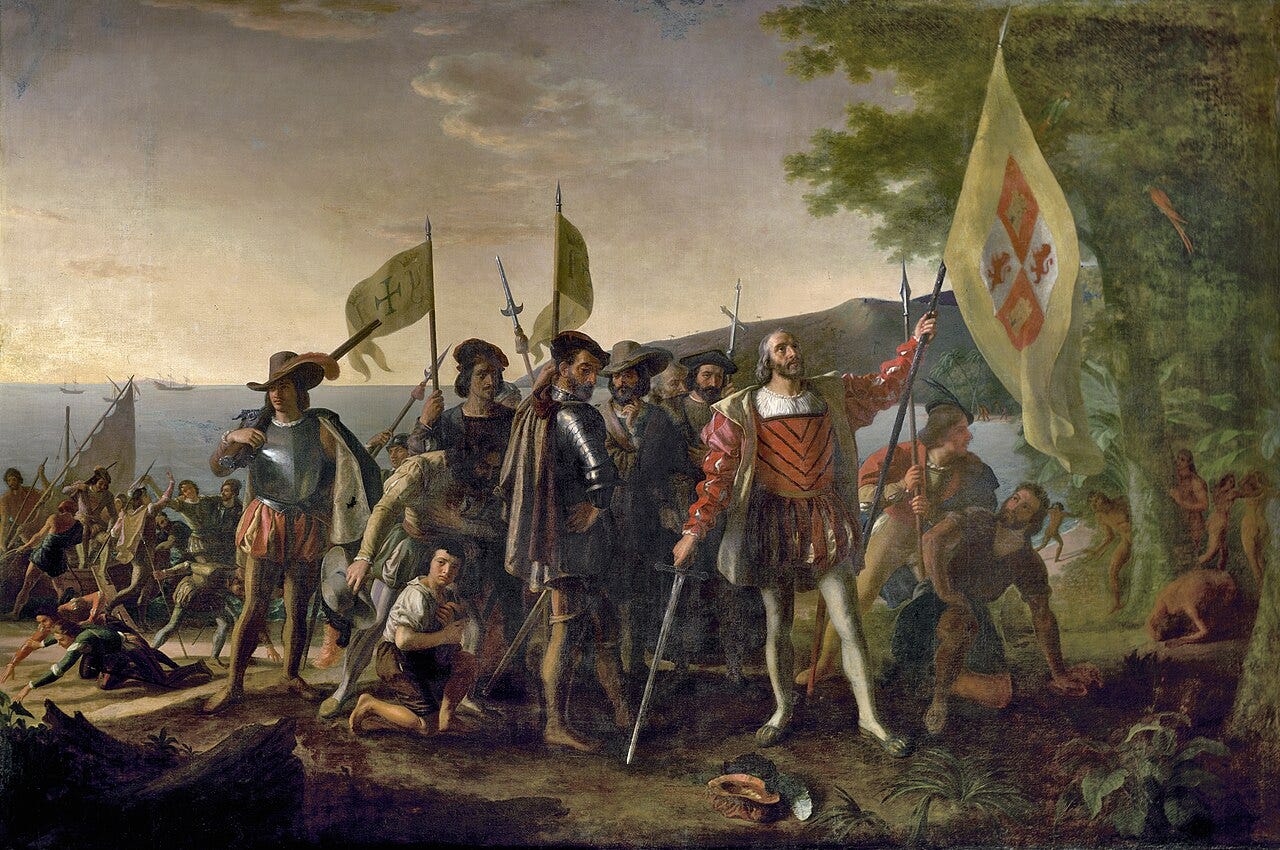
Columbus and his captains make landfall upon the Bahaman island of Guanahani on the morning of 12th October 1492. To mark the momentousness of the occasion, the admiral holds in one hand the Royal Banner of Castile and Aragon, in the other, his sword. Either side of him are brothers Martín Alonso and Vicente Yáñez, each holding aloft the Green Cross, the emblazoned sigil flanked on either side by the crowned initials of the Catholic Monarchs of Spain. Columbus calls forward Rodrigo Escobedo, the fleet notary, and Rodrigo Sanchez de Segovia, its inspector, to record his next words. He declares he is taking possession of this isle, out here at the far western edge of the great ocean sea, in the name of the most righteous Ferdinand and Isabella. This ceremony complete, the Europeans look up; they see strange people approaching.
This meeting, between the native Taíno of the Greater Antilles, and the sailors of Western Europe, is perhaps the closest we have come in history to a meeting between two alien species. They could not have hoped to understand one another, but even if they could have, how would the Spanish have explained that they had sailed across the vast vast sea, from a land of towering cathedrals and sprawling metropoleis, where kings could gather armies tens of thousands strong, and millions prayed to the son of a god who died for the world’s sins; and how could the Taíno have explained that their lives were governed by zemí, mysterious spirits of nature and ancestor who imbued their world and lives with meaning, that their society was knit together in a complex web of ritual and gift-giving, that the lustrous metal alloy they called guanín dangling from their noses came from a faraway land, and was the very essence of all that was good and sacred in this world? And how could they have known that the Europeans brought with them more than beads and bells, that in their very bodies they carried a devastation far more deadly than the Taíno could ever imagine — microscopic weapons of mass destruction that would soon level their entire way of being to the ground?
Neither could these two peoples, each so curiously wondering at the other, have known that once they’d been one, that two hundred and fifty centuries previous they had shared common ancestors, hunter-gatherers who scratched a living under the wild sky of the Siberian steppe, back when the great ice sheets of the Last Ice Age still swathed the frozen north. As the pale, sun-burnt Europeans squinted in the Caribbean sun at the dark-haired, bronze-skinned Taíno, they could have had no sense that nine hundred generations ago, the descendants of their ancient Eurasian forebears had parted ways, some bound westwards for Europe, the others eastwards to Beringia, the now-drowned land that had once bridged Asia and the Americas.
In his own words,1 Columbus describes what happens next:
